
Every day in Australia, approximately 90 people suffer a sudden cardiac arrest. Sadly, only 1 in 20 people survive.
But we can change that!
A sudden cardiac arrest occurs when the heart suddenly stops. The person is unconscious and not breathing normally, or not at all. This is a life-threatening emergency.
8 out of 10 sudden cardiac arrests occur in the home. This is why this program is so important—our children may find themselves in a situation where they are alone and have to help a family member.
But there is hope. If we witness a cardiac arrest and we step up immediately and start compressions, we double the person’s chance of survival. If an AED is used, the person’s chance of survival increases enormously, to around 50%.
This website is to help educate teachers, children (in our program we call them "Heart Starters") and their parents and siblings on what they can do to be prepared, in case they ever find themselves in a situation where they need to step up and become someone's lifeline.
Create account or login here
For school administrators only - request access to the program for your school.
Once your school admin account has been created, log in here.

Each teacher that teaches the program at a school requires an account
Any person who attends a school where the program has been taught, can create an account.
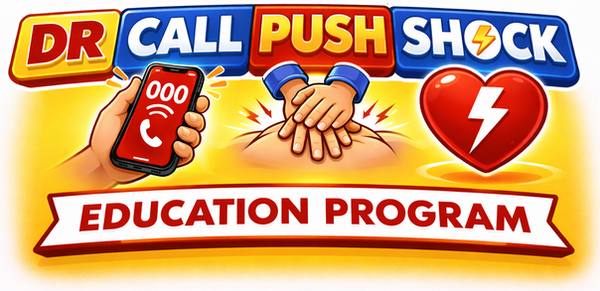
What is DR Call Push Shock?
Teaching children how to respond in a cardiac emergency requires more than just information — it requires memory, confidence and clarity under pressure.
The DR Call Push Shock program has been designed using simple, evidence-informed learning principles to help children not only understand what to do, but remember it - when it matters most.

Created by Experts With Lived Experience
The DR Call Push Shock Program was created and developed by educators Greg Page, original Yellow Wiggle, together with Craig Warner (School Principal) and Tayla Beedham (Stage 2 Educator) all with their own connections to sudden cardiac arrest. Find out more about their stories....
An evidence-based program

The DR Call Push Shock program was piloted in a primary school with over 150 students taking part, so we could evaluate how effectively students might learn the basics of responding to sudden cardiac arrest.
The results were beyond encouraging. After completing the program:
-
Students correctly identifying the steps to resuscitate someone increased from 16% to 92%;
-
Every student learned what an AED (defibrillator) is and why it is important;
-
Confidence in performing CPR increased significantly.
Just as importantly, when students were surveyed three months later, many were still able to recall key CPR concepts through the songs used in the program.
This suggests that combining hands-on learning, simple messaging, and music may help children retain life-saving knowledge.
The program was delivered by the regular classroom teachers, showing that it can be easily integrated into school learning environments and has the potential to reach students at scale.
Teaching children how to recognise cardiac arrest and respond using DR Call Push Shock could help prepare the next generation of life savers to act confidently in the event of a sudden cardiac arrest.
📈 16% → 92%
Students correctly identifying resuscitation steps
⚡ 56% → 100%
Students recognising the role of AEDs
❤️ 4.4 → 6.6 /10
Increase in confidence to attempt CPR
🎵 54 – 67% recall after 3 months
Students remembering CPR concepts through songs
Trial Program Impact - Highlights
The program introduces a friendly cartoon character, a “DR”, representing Danger and Response.
For many people, first aid training includes the acronym DRSABCD, but over time this can become difficult to recall in an emergency.
By bringing “DR” to life as a character, children learn to:
-
check for danger;
-
check if the person is responsive;
before moving into the Call, Push, Shock action.
This helps create a clear and memorable starting point without overwhelming them with complexity, and helps keep them safe.
A Character That Helps Learning Stick


Songs That Reinforce Life-Saving Steps
The program uses original songs to embed key actions such as:
-
calling for help
-
performing CPR
-
using an AED
Music and rhythm are powerful learning tools for children. Songs help turn important information into memorable patterns, making it easier for students to recall the steps later.
In our pilot program, more than half of the students were still able to recall key CPR concepts three months after the session through the songs they learned.
Bridging Formal and Informal Training

One of the key challenges in CPR education is the gap between what people learn in formal training (DRSABCD) and the simplified message used by emergency services (Call Push Shock). it often leads to confusion about the messaging.
The DR Call Push Shock program helps bridge that gap.
By introducing DR (Danger & Response) at the start, the program connects prior learning with a simple, action-focused sequence that links to the first part of the accredited training that is taught nationally. The last part of the program name is the call to action that is enunciated by emergency services all over the world. That led us to create....
DR → Call → Push → Shock
This approach helps children — and the families they share the message with — understand how formal first aid training translates into practical, easy to understand action in the case of a sudden cardiac arrest.
Create account or login here
For school administrators only - request access to the program for your school.
Once your school admin account has been created, log in here.
Each teacher that teaches the program at a school requires an account
Any person who attends a school where the program has been taught, can create an account.